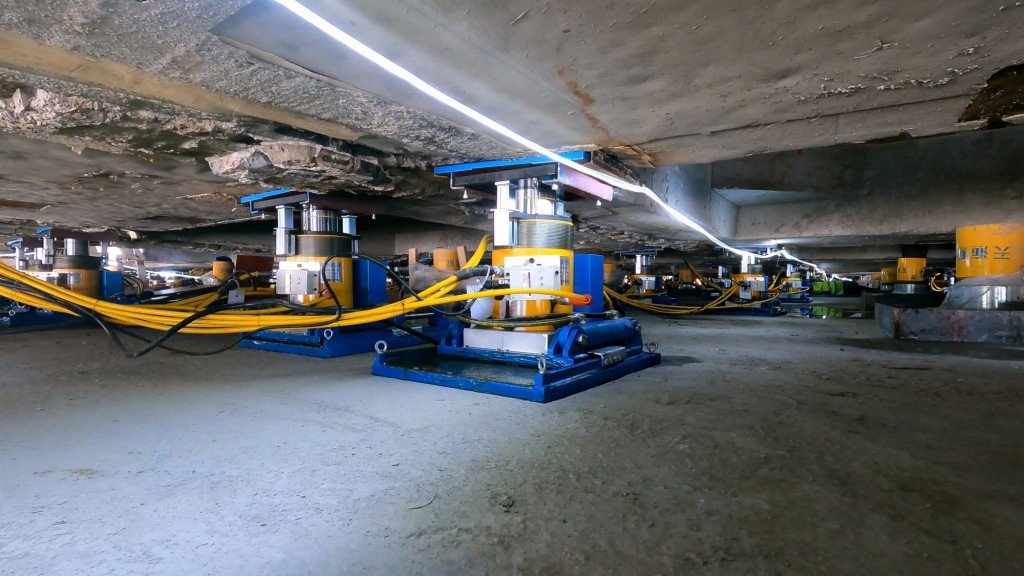
In a groundbreaking display of engineering and robotics, a team of small autonomous robots recently accomplished what once seemed impossible: moving an entire 7,400-tonne building complex. This feat marks a transformative moment in the fields of construction, automation, and urban redevelopment — showcasing not only the power of modern robotics but also how smart technology is redefining what machines can do in the real world.
A Giant Leap in Micro-Mobility
The event took place as part of a large-scale urban renewal project. Instead of demolishing the building, engineers opted to relocate it — preserving both its historical significance and structural integrity. But rather than relying on cranes, massive dollies, or human-operated equipment, a fleet of hundreds of tiny, wheeled robots was deployed to carefully transport the structure.


Each robot, roughly the size of a lunchbox, was equipped with advanced sensors, hydraulic lifters, and AI-powered navigation systems. Together, they lifted and slowly inched the building complex along a predetermined path to its new location — a process that took days but was executed with remarkable precision.
How Did It Work?
The underlying technology is called “swarm robotics,” a concept inspired by the behavior of social insects like ants or bees. While each robot is relatively simple on its own, their coordinated efforts result in a highly efficient, intelligent system. The robots communicated in real time, adjusted for terrain and weight shifts, and maintained even pressure to prevent structural damage.
The process can be summarized in three key stages:
- Mapping & Planning: Engineers digitally mapped the building, calculating weight distribution and identifying structural weak points. A path was designed that avoided obstacles and ensured a smooth relocation.
- Robot Coordination: The small robots were strategically placed under the structure. Each unit used hydraulic lifts to slightly raise its assigned portion of the building, while sensors ensured weight was evenly distributed.
- Movement & Monitoring: The robots slowly rolled forward in unison, guided by an AI system that tracked movement, alignment, and stability in real time. Engineers oversaw the operation remotely, intervening only when necessary.
Why Use Robots for This?
Using small robots instead of traditional equipment offers several advantages:


- Precision: Robots can make micro-adjustments that large cranes and dollies cannot, reducing risk of structural damage.
- Flexibility: The swarm system can adapt to uneven surfaces, narrow roads, or unpredictable terrain.
- Safety: Fewer human workers are needed on-site, which lowers the risk of injury.
- Preservation: Historical or delicate buildings can be preserved intact instead of being dismantled or demolished.
A Sign of the Future
This achievement highlights the growing potential of robotics in civil engineering. While robots have long been used in factories and warehouses, their ability to perform complex, coordinated tasks in unpredictable outdoor environments has lagged — until now.
Applications could include:
- Relocating heritage buildings during urban development
- Assisting in disaster zones by moving debris or stabilizing structures
- Constructing or deconstructing modular buildings with minimal labor
It also raises possibilities for more sustainable development. By reusing or relocating existing structures rather than tearing them down, cities can reduce construction waste, lower emissions, and preserve cultural landmarks.
A Historic First — But Not the Last
This isn’t the first time robots have been used to move structures, but it is certainly one of the largest and most complex. Previously, larger mobile platforms were required to shift heavy structures, often with significant preparation and risk. This new method proves that swarms of intelligent, mobile micro-robots can handle loads once thought far beyond their capacity.
In an era where AI and automation are reshaping every industry, this project stands as a vivid example of innovation meeting real-world needs. It may not be long before the sight of small robots quietly carrying buildings — or even assembling them — becomes not just a technological marvel, but a standard practice in cities around the world.