The mysterious depths of the ocean continue to reveal astonishing surprises, and a recent deep-sea sighting off the coast of Argentina has captured global attention. Marine researchers reported encountering a massive jellyfish—described as nearly the size of a bus—gliding slowly through the dark waters. This rare discovery has sparked excitement among scientists and ocean enthusiasts alike, offering new insights into deep-sea biodiversity and reminding us how little we truly know about the underwater world.
The sighting occurred during an oceanographic research expedition focused on studying deep-sea ecosystems in the South Atlantic. Using remotely operated vehicles (ROVs) equipped with high-definition cameras and advanced sensors, researchers were exploring areas far below the ocean’s surface when they noticed an enormous, translucent shape drifting gracefully through the water. Its immense bell and long trailing tentacles created a hauntingly beautiful image, immediately capturing the team’s attention.

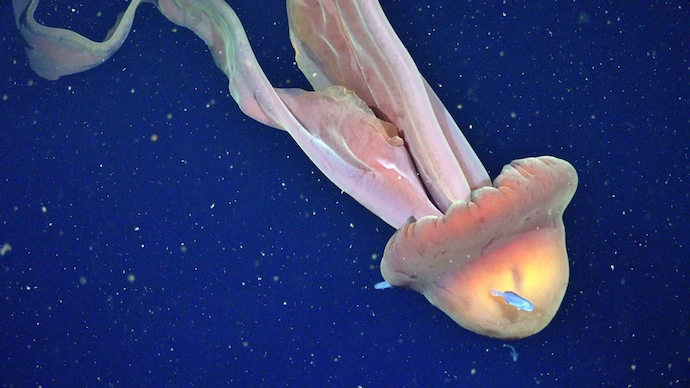
Giant jellyfish are not entirely unknown, but sightings of individuals this large are extremely rare. Many deep-sea species remain undocumented because of the immense pressure, darkness, and logistical challenges involved in exploring such remote environments. Scientists believe that the bus-sized jellyfish may belong to a species that is either poorly understood or potentially new to science. Further analysis of video footage and environmental data will be required before researchers can confirm its classification.
One of the most fascinating aspects of the encounter was the jellyfish’s slow, almost effortless movement. Unlike smaller species that pulse rapidly through shallow waters, this enormous creature appeared to glide gently, using subtle contractions to navigate the deep-sea currents. Its translucent body allowed internal structures to be faintly visible, creating a mesmerizing display as it passed in front of the ROV’s lights. For many scientists on the expedition, the moment was both surreal and unforgettable.
The deep ocean, often referred to as Earth’s last frontier, is home to countless species adapted to extreme conditions. Temperatures are near freezing, sunlight does not penetrate beyond certain depths, and food sources can be scarce. Creatures that inhabit these environments often develop unique survival strategies, such as bioluminescence, slow metabolisms, or enormous sizes that help conserve energy. The discovery of such a massive jellyfish raises questions about how it feeds, reproduces, and interacts with other marine life in its ecosystem.
Encounters like this also highlight the importance of technological advancements in ocean exploration. Modern ROVs and deep-sea submersibles allow scientists to observe fragile marine organisms without disturbing their natural habitats. High-resolution cameras capture details that were once impossible to study, providing valuable data for marine biologists and conservationists. As technology continues to improve, researchers hope to uncover even more hidden wonders beneath the ocean’s surface.
However, the discovery also brings attention to the fragile nature of deep-sea ecosystems. Human activities such as deep-sea mining, climate change, and pollution pose growing threats to marine environments that are still largely unexplored. Many scientists emphasize the need for responsible research and conservation efforts to protect these mysterious habitats before they are significantly altered. Rare sightings like the Argentine jellyfish remind us that countless species may exist beyond our current knowledge, making ocean preservation more crucial than ever.
Public fascination with giant sea creatures is nothing new, but real-life discoveries often surpass imagination. The image of a bus-sized jellyfish drifting silently through the depths has captivated people worldwide, sparking renewed interest in marine science and ocean exploration. Social media and news coverage have helped bring the story to a global audience, encouraging curiosity about the unknown life forms that inhabit our planet’s vast oceans.

Ultimately, this remarkable sighting is more than just a viral headline—it is a powerful reminder of the ocean’s immense biodiversity and the ongoing importance of scientific exploration. Each new discovery expands our understanding of marine ecosystems and highlights the incredible adaptability of life on Earth. As researchers continue to analyze footage and gather data, the giant jellyfish off Argentina may reveal new secrets about deep-sea life and the delicate balance of underwater environments.
In a world where so much of the planet has been mapped and studied, the deep ocean remains one of the few places where true mysteries still exist. The encounter with a bus-sized jellyfish not only amazes but also inspires future exploration, reminding humanity that the wonders of the natural world are far from fully discovered.