Some landscapes feel designed for postcards; others feel dreamed into existence. Bolivia’s Altiplano—the vast high plateau that stretches beneath the Andes—belongs firmly to the latter. At more than 3,500 meters above sea level, it is a place where the sky feels closer, colors seem sharper, and reality bends just enough to make you question your senses. Traveling here is not merely a journey; it is an encounter with the planet’s wild imagination.
My adventure began in Uyuni, a dusty little town that sits on the edge of Bolivia’s most famous natural wonder: the Salar de Uyuni. Uyuni itself is simple, with low-slung buildings, colorful murals, and a few market stalls selling alpaca gloves and salt carvings. It exists not for spectacle, but for purpose—an unassuming gateway to the extraordinary.
At dawn, I climbed into a 4×4 with a small group of fellow travelers. The air was crisp enough to sting, and the sky unfurled in deep purples and blues. As we drove out of town, a quiet anticipation filled the car. And then, quite suddenly, the world opened up.

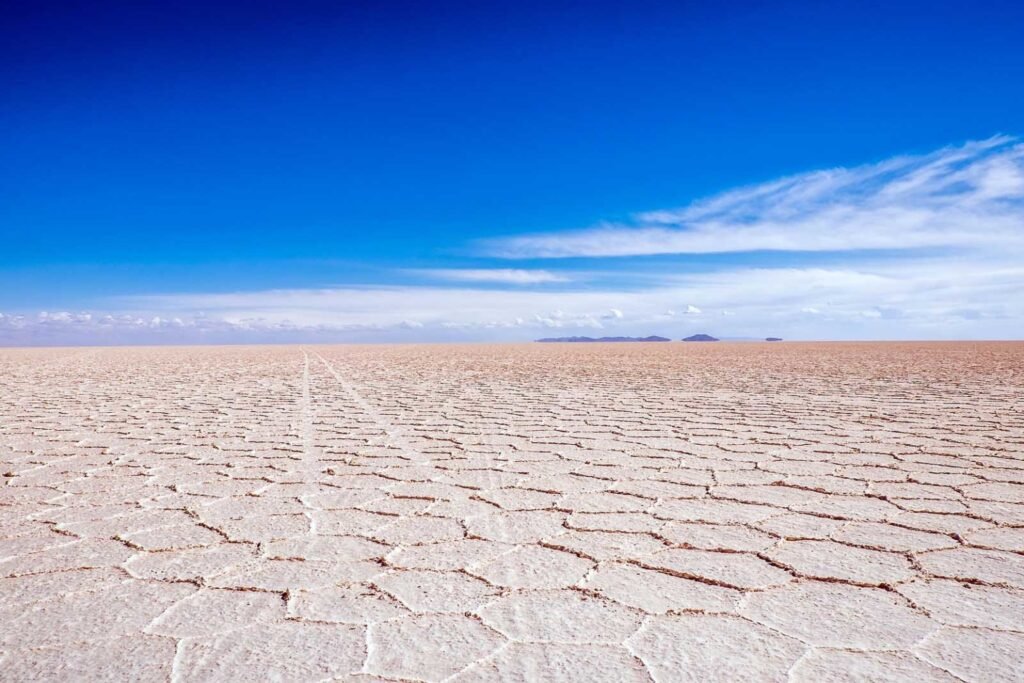
The Salar de Uyuni is impossible to describe without eventually saying: It doesn’t look real. An endless sheet of white salt stretches to the horizon in a smooth, glittering expanse. From afar, it resembles frozen ocean; up close, it is a mosaic of hexagonal patterns naturally carved by the earth. When the sun rises, the ground becomes a giant mirror—reflecting the sky so perfectly that it feels like floating inside an optical illusion. We stopped in the middle of this vast brightness, and for a long moment, everyone fell silent. The immensity rearranges your understanding of size, distance, and self.
In the center of the salt flat lies Incahuasi Island, an otherworldly mound of ancient coral covered in towering cacti. Some rise more than ten meters high, casting strange shadows over the salt. Walking among them feels like stepping into a surreal painting—cacti reaching upward, sky mirrored beneath your feet, and the silent plains extending in every direction.
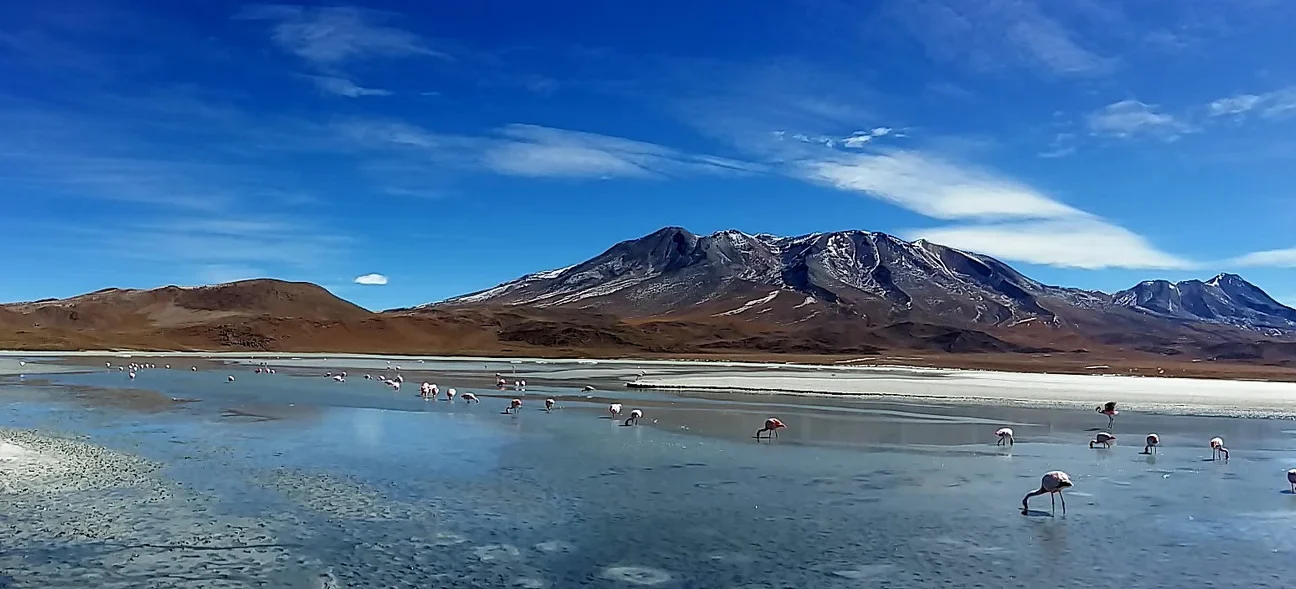
After lunch, our journey continued southward toward the Altiplano lagoons, each more striking than the last. The first was Laguna Cañapa, where flamingos gathered in delicate clusters, their pale-pink wings fluttering gently over turquoise water. Behind them, volcanic peaks loomed in shades of rust and charcoal. It was a scene so vibrant that it looked unreal, yet it pulsed with life.
Farther along, the road became a rugged trail through shifting sands and stone. Dust curled behind the jeep like a golden ribbon. The landscape changed constantly—flat deserts gave way to volcanic fields, which in turn opened into valleys dotted with hardy shrubs that had learned to survive the altitudes. We passed herds of vicuñas, their slender bodies poised gracefully against the wind.
The highlight of the day was Laguna Colorada, the famed red lagoon. Its waters shine in astonishing shades of crimson due to algae and minerals, and thousands of flamingos—three different species—gather there to feed. The wind swept across the lake, sending ripples through the red surface as the flamingos danced in slow, elegant motions. Above us, clouds drifted in long white streaks, creating a sky almost as mesmerizing as the lagoon itself.
Night in the Altiplano is something else entirely. We reached a basic lodge near the Sol de Mañana geysers, where the temperatures plunged quickly. After dinner, I stepped outside into the cold darkness—and gasped. The sky wasn’t just full of stars; it overflowed. The Milky Way glowed like a luminous river, stretching across the heavens in shimmering detail. At this altitude, the stars feel almost within reach. The silence is so complete that you hear your heartbeat more clearly than the wind.

The next morning, we visited the geysers themselves. At sunrise, the earth hissed and roared, releasing plumes of steam that rose dramatically into the icy air. The ground bubbled with geothermal fury while the mountains watched from every direction—a thrilling display of the planet’s restless energy.
Finally, we ended at Laguna Verde, a lake the color of mint and jade, set beneath the towering Licancabur Volcano. The water shimmered in the cold breeze, glowing like a precious gem amid the barren desert.
The Altiplano doesn’t charm—it astonishes. It strips the world down to earth, sky, and wind, then rebuilds it in colors and textures that feel borrowed from dreams. It’s a place where silence speaks loudly, where landscapes shift like stories, and where nature shows you just how wild and imaginative it can be.