

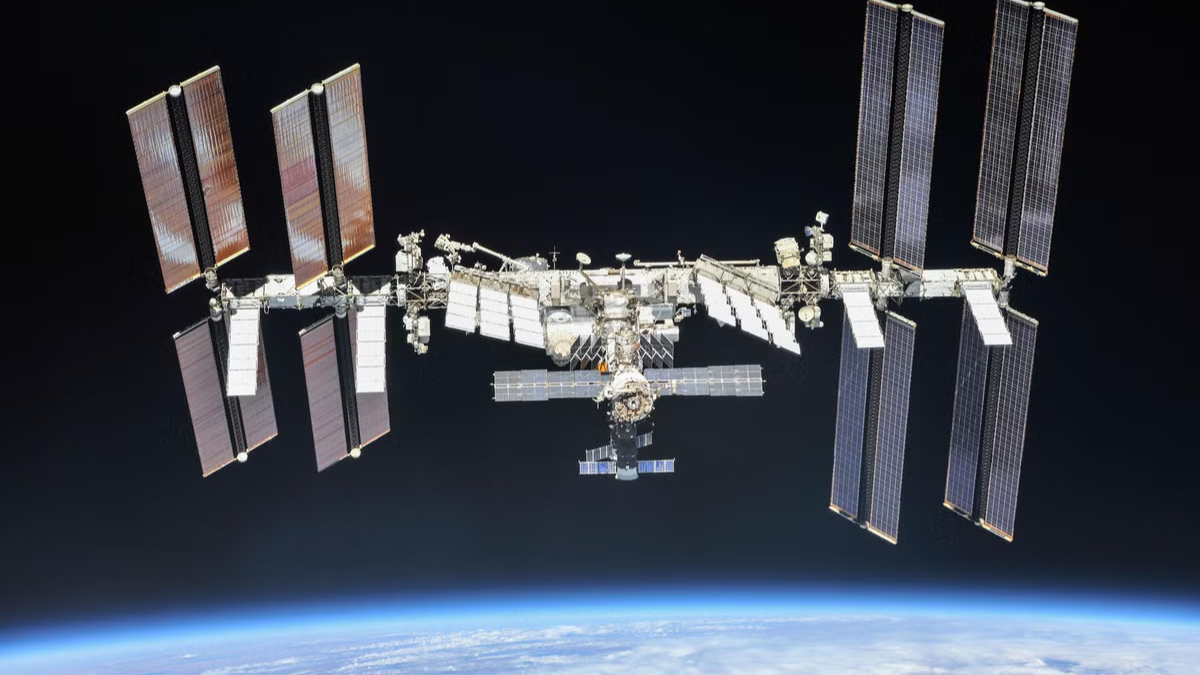
SpaceX will employ an enhanced capsule to deorbit the International Space Station when its operational life ends. NASA and Elon Musk’s company detailed the strategy on Wednesday to incinerate the space station upon reentry and safely dispose of remaining debris in the ocean by early 2031, coinciding with its 32nd year of operation.
The space agency dismissed other options such as dismantling the station for return to Earth or transferring ownership to another entity. NASA has awarded SpaceX an $843 million contract to deorbit the station, which is the largest structure ever constructed beyond Earth.
Why is the space station getting deorbited?

The space station is showing signs of wear and tear. It was first assembled with components launched by Russia and the US in 1998, and astronauts began living aboard two years later. Subsequently, Europe and Japan added their own modules, and Canada supplied robotic arms. By the time NASA’s shuttles were retired in 2011, the station had grown to the size of a football field and weighed almost 1 million pounds (430,000 kilograms).
NASA estimates that the station will remain operational until at least 2030. The plan is for private companies to establish their space stations by then, with NASA being one of many customers. This strategy, already used for cargo and crew deliveries, will allow NASA to concentrate on missions to the Moon and Mars. NASA may extend the station’s lifespan if commercial outposts are not yet established, ensuring that scientific research continues without interruption.
Why is it not being returned to Earth?

NASA explored options such as dismantling the space station and returning the components to Earth, or allowing private companies to retain parts for their planned outposts. However, NASA stated that the station was not designed to be disassembled in orbit, and any such endeavor would be costly and pose risks to the astronauts involved in handling the disassembly process.
There is no spacecraft as large as NASA’s retired shuttles available to bring everything back to Earth. Another option would have been to raise the empty station to a higher, more stable orbit. However, this idea was also rejected due to logistical challenges and the risk of space debris.
How will the space station be brought down?
Visiting spacecraft regularly adjust the space station’s orbit to keep it approximately 260 miles (420 kilometers) above Earth. Without these adjustments, the station would gradually lower in altitude until it reenters the Earth’s atmosphere uncontrollably. NASA plans for a safe reentry over a remote area in the South Pacific or potentially the Indian Ocean, requiring the launch of a spacecraft to dock with the station and guide it to a controlled descent into the ocean.

NASA expects that some of the larger components, ranging from the size of a microwave oven to a sedan, will survive reentry into a debris field covering 1,200 miles (2,000 kilometers). Initially, NASA and its partners planned to use three Russian supply ships for this mission, but a more durable spacecraft was found to be necessary. Consequently, the industry was invited to bid, and in June, SpaceX won the contract to provide the deorbit vehicle.
Will anything be preserved?
NASA plans to retrieve select small items from inside the space station for museum display, such as the ship’s bell, logs, panels adorned with patches, and other mementos. These artifacts can be brought back to Earth aboard SpaceX supply ships during the station’s final year or two of operation.
“Unfortunately, we can’t recover very large items,” said NASA’s Ken Bowersox. “While I’d personally love to try and salvage some of them,” he continued, “the most practical solution is to bring everything down in one controlled operation.”






Leave feedback about this